

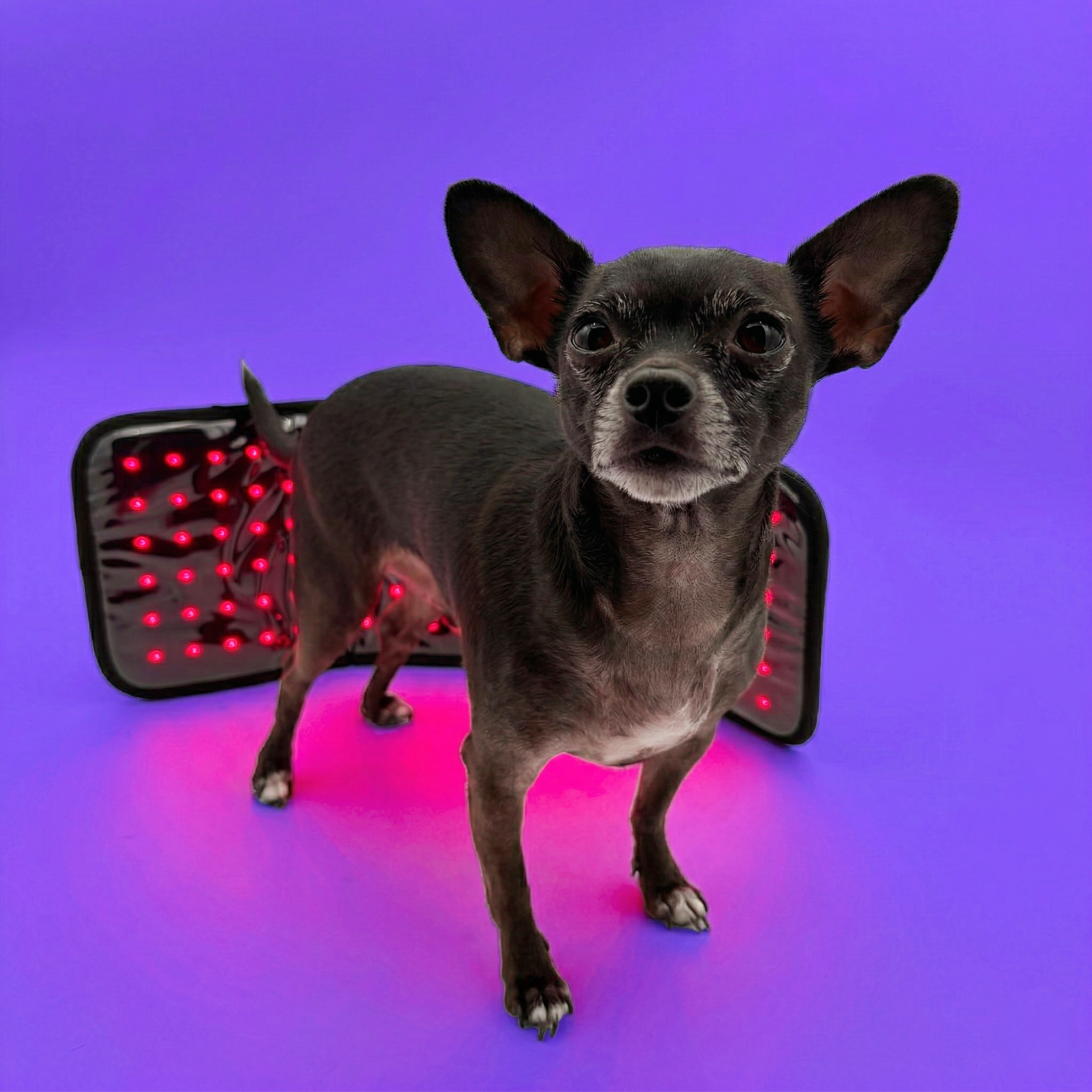
Red light therapy for dogs: How it works, what the research shows, and how to use it at home.
Red light therapy for dogs uses red and near-infrared light to ease joint pain, accelerate wound healing, and improve mobility in aging or injured dogs. The therapy is non-invasive, drug-free, and pain-free. About 43 percent of US veterinarians now use it on canine arthritis patients, and the home-use version of the technology has become accessible enough that most pet parents can deliver daily sessions on the same evidence base their veterinarian uses in clinic.
This guide walks through how red light therapy works on a dog's body, what conditions it helps with, what the veterinary research actually shows, how coat thickness and breed size affect dose, and how to choose a device for at-home use. If you have a senior dog, an active dog recovering from injury, or a dog with chronic joint pain, this is where to start.


How red light therapy works on a dog's body.
Red light therapy works at the cellular level. The mechanism is identical in dogs, cats, horses, and humans — mammalian cells respond to therapeutic light the same way regardless of species. The clinical name is photobiomodulation, often shortened to PBM. Veterinarians may also call it low-level laser therapy (LLLT) or cold laser therapy. All three names describe the same therapeutic category.
When red and near-infrared light reach the skin, photons travel through the outer tissue and are absorbed by structures inside the cell called mitochondria. Mitochondria produce a molecule called adenosine triphosphate, or ATP — the energy currency of every cell. Red and near-infrared wavelengths stimulate the mitochondria to produce more ATP, which gives cells more energy to repair, regenerate, and clear inflammation. The therapy also triggers the release of nitric oxide, a signaling molecule that improves blood flow to the treated area.
Dogs benefit from light penetration up to about 14 millimeters of tissue depth, which is enough to reach most surface joints, soft tissue, and superficial muscle. Larger dogs and dogs with thick double coats absorb more light at the surface, so longer sessions or direct skin contact may be needed to deliver the same dose to deeper tissue.
Eight conditions red light therapy can help dogs with.
Veterinary research and clinical use support red light therapy for a defined range of conditions in dogs. The therapy works alongside veterinary care, not in place of it.
Arthritis and osteoarthritis. The most studied indication. A 2018 study on dogs with elbow osteoarthritis showed significant pain reduction and reduced dependence on pain medication after six weeks of red light therapy. Manufacturers like Lumaflex have published clinical data showing 72 percent improvement in mobility for arthritic dogs within four weeks of consistent use.
Hip dysplasia. Studies published in the Journal of Orthopaedic Surgery and Research have documented improvements in mobility and pain scores in dogs with hip dysplasia following photobiomodulation. The therapy reduces joint inflammation and supports cartilage health.
Intervertebral disc disease (IVDD). IVDD is common in small breeds with long backs — Dachshunds, Corgis, French Bulldogs. Red light therapy supports nerve recovery, reduces local inflammation, and is often part of a broader treatment plan that includes rest, anti-inflammatories, and sometimes surgery.
Cruciate ligament injuries and post-TPLO recovery. Dogs recovering from cruciate ligament tears or surgical repair (TPLO, TTA, or extracapsular) benefit from red light therapy applied around the surgical site. The therapy accelerates collagen production and supports new blood vessel formation at the repair site.
Wound healing and post-surgical recovery. A 2017 study examined dogs undergoing bone surgery — those who received red light therapy before surgery showed faster healing at 8 weeks compared to controls. Open wounds, surgical incisions, and slow-healing skin lesions all respond to consistent treatment.
Skin conditions and hot spots. Hot spots, chronic dermatitis, and pododermatitis (paw inflammation) often respond to red light therapy. A 2016 study on dogs with pododermatitis showed improvement after consistent treatment. The therapy supports the skin's natural repair without the side effects of long-term medication.
Muscle strains and soft tissue injuries. Working dogs, agility competitors, and active pets recover faster from minor strains and sprains with regular sessions on the affected area. The therapy is also useful as warm-up support for dogs with chronic compensation patterns.
Senior stiffness and general aging support. Aging dogs slow down for many reasons — joint degradation, muscle loss, reduced circulation. A daily session helps with all three through different mechanisms. Many owners use red light therapy as part of senior wellness, not waiting for a specific diagnosis.

What the veterinary research says about red light therapy for dogs.
Veterinary photobiomodulation research has accumulated steadily over the past two decades. The strongest evidence is for musculoskeletal applications: arthritis, hip dysplasia, cruciate injuries, and post-surgical recovery. The 2018 elbow osteoarthritis study used accelerometers to measure activity and documented increased physical activity starting at week 2 with sustained improvement through week 6. The dogs in the treatment group also reduced their pain medication intake. Studies in the Journal of Orthopaedic Surgery and Research and the Journal of the American Veterinary Medical Association have confirmed similar outcomes for hip dysplasia and IVDD.
Adoption among veterinarians reflects this evidence. A recent survey of US veterinarians found that 43 percent are using red light therapy on canine arthritis patients — a number that has grown alongside the consumer device market. The International Association of Animal Hospice and Palliative Care has identified red light therapy as one of the most promising non-pharmaceutical pain management options for senior dogs.
The honest limit: photobiomodulation is established for musculoskeletal pain, mobility support, soft tissue recovery, and post-procedure recovery when wavelength, dose, and treatment interval match the target tissue. Evidence is moderate for select indications, less robust for others, and varies by condition and study design. Red light therapy is not a stand-alone cure for any of these conditions. It works best as an adjunct to veterinary diagnosis and standard care.

Coat thickness and skin tone affect how the light reaches your dog.
Light absorption depends on what the light passes through. A short-haired Pit Bull with light-pigmented skin absorbs less light at the surface than a black Labrador or a thick double-coated Husky. The wavelengths used in red light therapy (660nm and 850nm) are tuned to penetrate skin and fur, but coat thickness and dark pigmentation can reduce the dose that reaches the underlying tissue.
The practical adjustment is simple. For dogs with dark fur or thick double coats, run sessions slightly longer (25-30 minutes instead of the standard 20) and place the pad against the thinnest-fur areas — the belly, the inner thigh, the armpit fold, or directly under the dog while they rest on their side. For shorter-haired or lighter-coated dogs, the standard 20-minute session at standard placement works well. Direct skin contact always delivers more dose than light filtered through fur.
At-home sessions vs clinical cold laser at the vet.
Many veterinary clinics offer in-office cold laser or red light sessions. They use higher-power Class IV lasers and charge $40-$100 per session. Home devices use LED arrays at lower individual power but enable daily use. For most chronic conditions, the right answer is both: a few clinic sessions to confirm protocol, then daily at-home maintenance.
| Factor | At-Home Pad / Device | Clinic Cold Laser |
|---|---|---|
| Cost per session | Effectively free after device purchase | Typically $40–$100 per session |
| Cost over 6 months daily | $137 device + $0 = $137 | 180 sessions × $60 avg = $10,800 |
| Frequency feasible | Daily or as needed | Once or twice per week |
| Stress level for the dog | Low — home environment | Travel + waiting room + handling |
| Power per session | Strong consumer-grade LED | Higher clinical-grade laser |
| Cumulative dose over time | High (volume × consistency) | Higher per session, lower volume |
| Protocol guidance | Self-directed with vet input | Veterinarian-guided |
For chronic arthritis, hip dysplasia, or IVDD, the cumulative dose from daily 20-minute home sessions typically outperforms 1-2 weekly clinic sessions over a 6-month window. Acute injury or post-surgical recovery often benefits from a clinic protocol established first, then home maintenance.
How to introduce red light therapy to your dog.
The first three sessions matter more than the next thirty. If your dog associates the device with calm and comfort, every session afterward gets easier. If they associate it with restraint or stress, you have an uphill climb.
Place the pad in their normal rest spot. Their bed, their crate, the sofa — anywhere they already lie down voluntarily. Do not introduce a new location at the same time as the new device.
Don't force contact. Lay the pad down. Let them sniff and investigate. Most dogs approach within a few minutes once they sense the warmth. Anxious or rescue dogs may take a few more minutes.
Start short. 5-10 minutes the first session. Work up to the full 20-minute dose by session three or four. You're training the routine, not chasing a clinical dose on day one.
Use a positive cue. A treat the first time. A familiar blanket draped over the pad. A favorite chew toy on the pad. Whatever the dog already associates with safety.
Watch their body language. A dog who settles, sighs, stretches, or falls asleep is responding well. A dog who paces, looks at you with whale-eye, or walks away is telling you to slow down. Try again later. Forcing it backfires.
By session three or four, most dogs walk over to the pad on their own. That's the goal. The therapy works best when it becomes part of the daily rhythm rather than a forced event.

How to choose a red light therapy device for your dog.
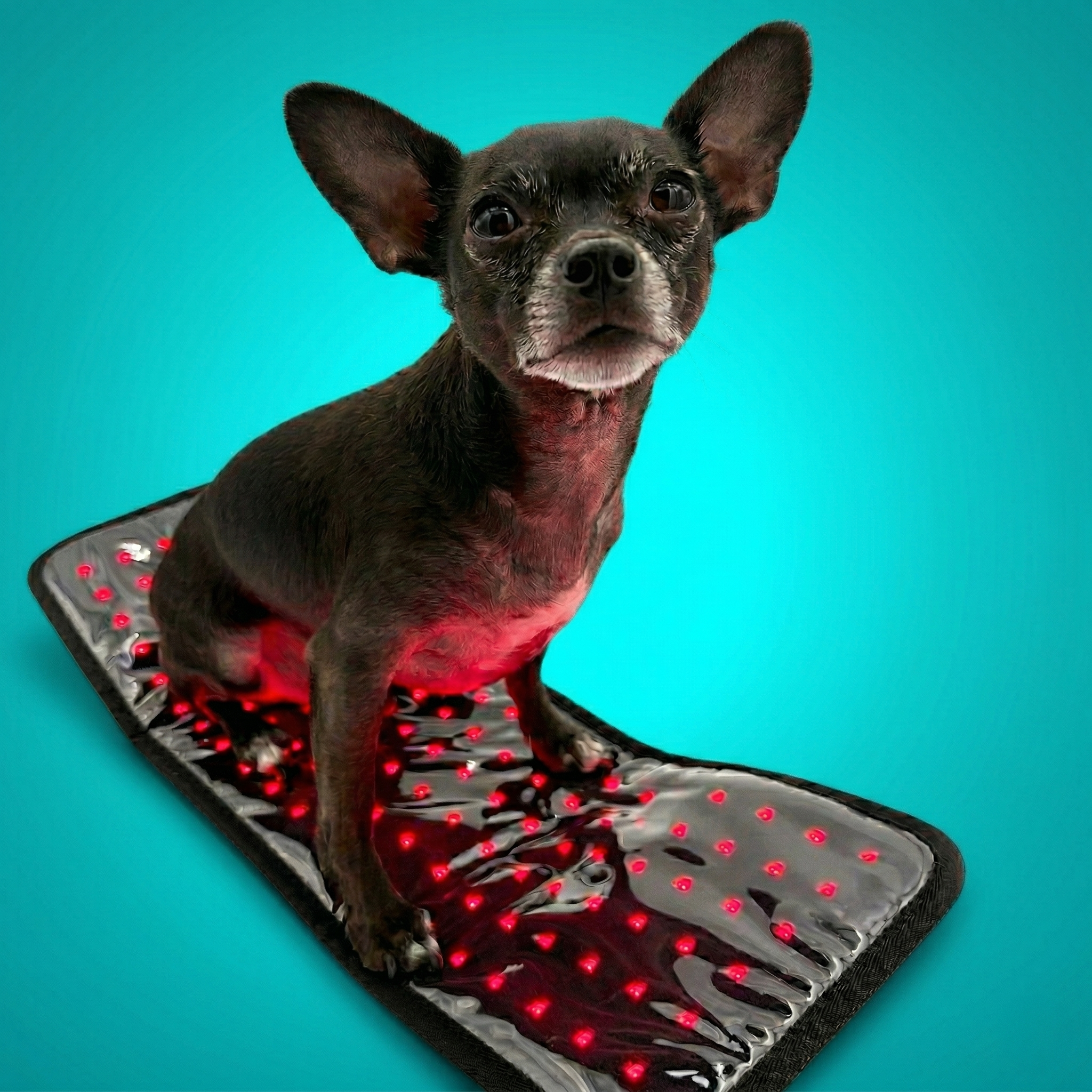
Pet red light therapy devices come in three main form factors: pads (best for medium-large dogs and any dog who already has a favorite resting spot), handheld wands (best for targeted spots on cooperative dogs), and wraps (best for dogs with a known target like a chronic elbow or recovering ACL). Pads are the most common at-home choice for general use because the dog can lie on them voluntarily — no holding, no chasing.
When evaluating a device, look at five things:
1. Wavelengths. 660nm red and 850nm near-infrared are the standard therapeutic pair. Avoid devices that only specify 'red light' without giving a wavelength. The Red Light Pet Mat from Red Light Wellness uses 660nm and 850nm.
2. Irradiance. Irradiance is the energy density at the surface, measured in milliwatts per square centimeter. Higher numbers mean shorter sessions for the same dose. The Red Light Pet Mat delivers 140 mW/cm². Avoid devices that don't publish their irradiance — if they're hiding it, it's usually low.
3. Treatment area. A pad covering 16 by 7 inches treats most of a small dog and a substantial portion of a medium dog in one session. For large breeds, you'll move the pad to different body areas across sessions.
4. Built-in timer. The 20-minute dose is the standard daily session. A built-in timer prevents over-exposure and makes the session repeatable without watching the clock.
5. Certifications. FDA registration, CE marking, RoHS compliance. These confirm the device meets manufacturing and safety standards. The Red Light Pet Mat carries all three.
You can see the Red Light Pet Mat and the rest of the Wellness Collection for the full lineup of consumer-grade red light therapy devices from Red Light Wellness.

How often to use red light therapy on your dog.
Frequency depends on the condition. General veterinary photobiomodulation guidance:
• Acute injury or post-surgery: Once or twice daily for the first 1-2 weeks, tapered to maintenance once healing is established.
• Chronic arthritis or hip dysplasia: Daily 20-minute sessions, indefinitely. Cumulative dose drives the result more than any single session.
• IVDD or post-cruciate recovery: Once or twice daily during the active recovery window (typically 4-8 weeks), then 3-5 times weekly for maintenance.
• Senior wellness without specific diagnosis: 3-5 times per week is sufficient.
• Skin conditions and hot spots: Daily until the area heals, then as needed for recurrence.
Consistency outperforms intensity. A daily 15-minute session over 4 weeks produces better results than a single hour-long session once a week. The cellular response to photobiomodulation accumulates over time. Tissue takes weeks to remodel.

What red light therapy cannot do for your dog.
Red light therapy is well-supported for what it does. It is not a cure-all.
It will not reverse advanced osteoarthritis or rebuild lost cartilage from scratch. It will not eliminate the need for pain medication in dogs with severe pain. It cannot replace surgery for cruciate ruptures, severe IVDD, or other structural conditions. It does not work overnight, and visible improvement on chronic conditions typically takes 2-4 weeks of consistent daily sessions.
What it does is well-defined: it supports the body's repair mechanisms, reduces inflammation, improves blood flow, eases pain, and accelerates healing. Used consistently and applied with realistic expectations, it adds quality of life and mobility for many dogs — especially aging ones — and often reduces (though rarely eliminates) the need for daily anti-inflammatory medication. If your dog has a serious medical condition, red light therapy belongs alongside veterinary care, not in place of it.
Frequently asked questions about red light therapy for dogs.
-
Yes, with the right device, the right wavelengths, and consistent use. The 2018 study on dogs with elbow osteoarthritis showed measurable pain reduction and reduced reliance on pain medication after 6 weeks. Approximately 43 percent of US veterinarians use it for canine arthritis. Results vary by condition, dog, and protocol — acute conditions improve in 3-7 days, chronic conditions in 2-4 weeks.
-
The biological mechanism is the same. The technical difference is in how the light is produced. Cold laser uses coherent focused light; LED-based home devices use broader diffuse light. For most home use cases, well-designed LED devices deliver comparable cumulative results because they enable daily sessions instead of weekly.
-
For general use, a flexible pad with dual 660nm/850nm wavelengths, irradiance of at least 100 mW/cm², a built-in timer, and FDA registration is the right combination. Pads work better than handhelds for most dogs because they don't require holding still. The Red Light Pet Mat from Red Light Wellness meets all these criteria.
-
Twenty minutes is the standard daily dose. Start shorter (5-10 minutes) for the first 2-3 sessions to let your dog adjust. For dark or thick-coated dogs, sessions of 25-30 minutes deliver more dose to deeper tissue.
-
Acute conditions like minor wounds or muscle strains often show improvement within 3-7 days. Chronic conditions like arthritis or hip dysplasia typically need 2-4 weeks of daily sessions before owners notice meaningful changes in mobility. Some dogs respond faster. Consistency over weeks is the variable that matters most.
-
Most veterinary photobiomodulation guidance recommends avoiding direct treatment over growth plates in young dogs whose bones are still developing. For minor wounds or skin conditions, brief targeted use is generally considered safe, but the broader-area daily use described in this guide is best reserved for adult dogs.
-
Yes, and this is the most common use case. Red light therapy is typically additive to medication, not a replacement. Many dogs reduce (but do not eliminate) their NSAID dose after several weeks of consistent therapy. Any medication change should be discussed with your veterinarian.
-
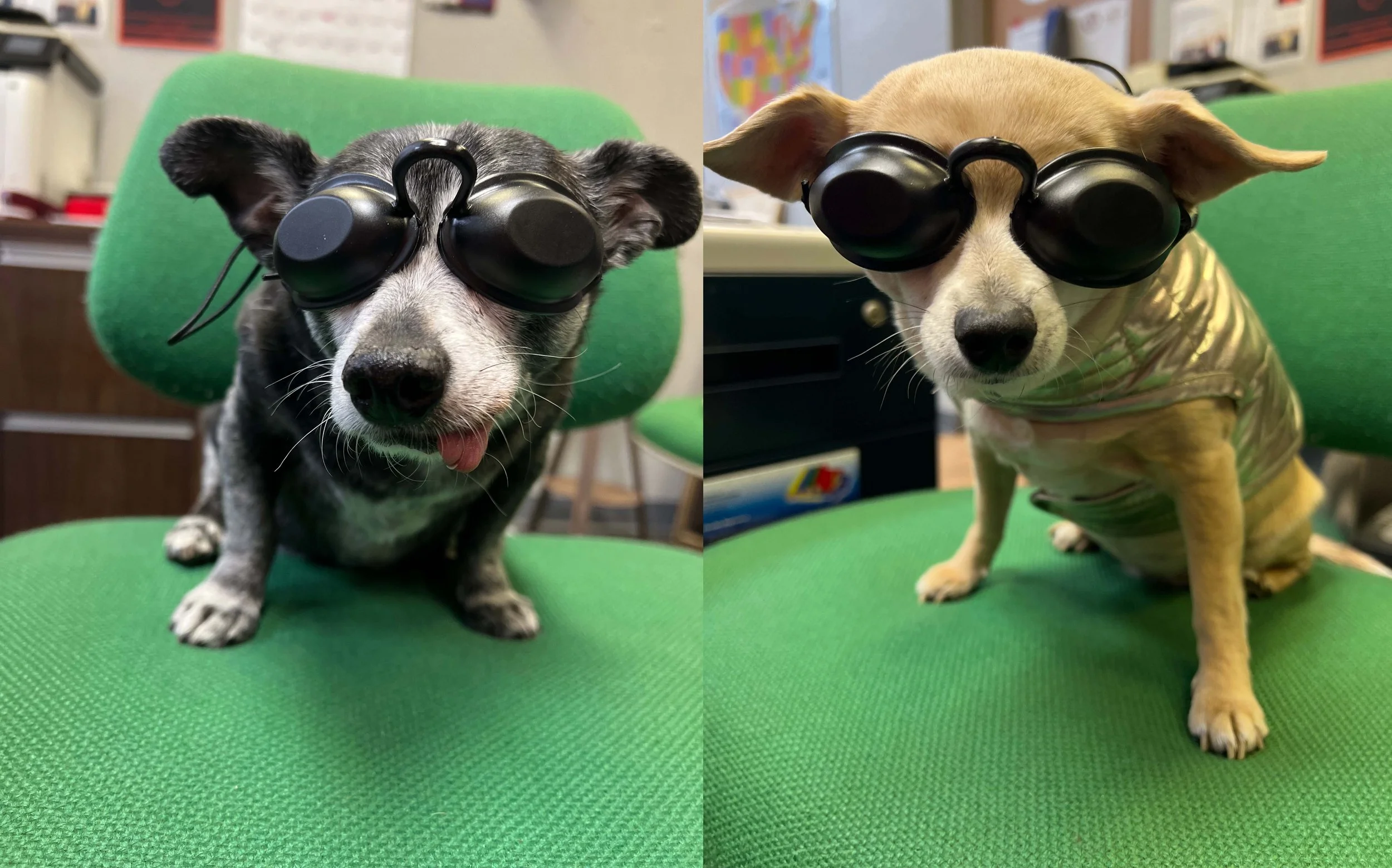
Skip direct treatment over known tumors without veterinary approval, over the eyes, on pregnant dogs (the research on pregnancy is limited), and during active infection requiring medical management. Confirm with your vet if your dog is on a photosensitive medication.

Bringing red light therapy home for your dog.
Red light therapy gives dog owners a non-invasive, drug-free, evidence-supported tool to manage joint pain, accelerate healing, and add quality of life to aging dogs. The veterinary research is solid for the conditions it addresses, the technology is now accessible at home, and consistent daily use is more important than any single session.
If your dog is slowing down with age, recovering from a strain or surgery, or has been on long-term anti-inflammatories, red light therapy is worth adding to the daily routine — alongside your veterinarian's guidance, not in place of it.
The Red Light Pet Mat from Red Light Wellness is built for daily at-home use. A 16 by 7 inch flexible pad. 120 LEDs. Dual 660nm and 850nm wavelengths. 140 mW/cm² irradiance. A simple 20-minute timer. Designed to be the spot your dog keeps coming back to.
Help your dog move more comfortably with daily, drug-free red light therapy at home.
This article is for educational purposes and does not replace professional veterinary advice. If your pet has a diagnosed condition or is on medication, consult your veterinarian before adding red light therapy to their care routine.