

EVIDENCE-LED ANSWER · DOG OWNERS
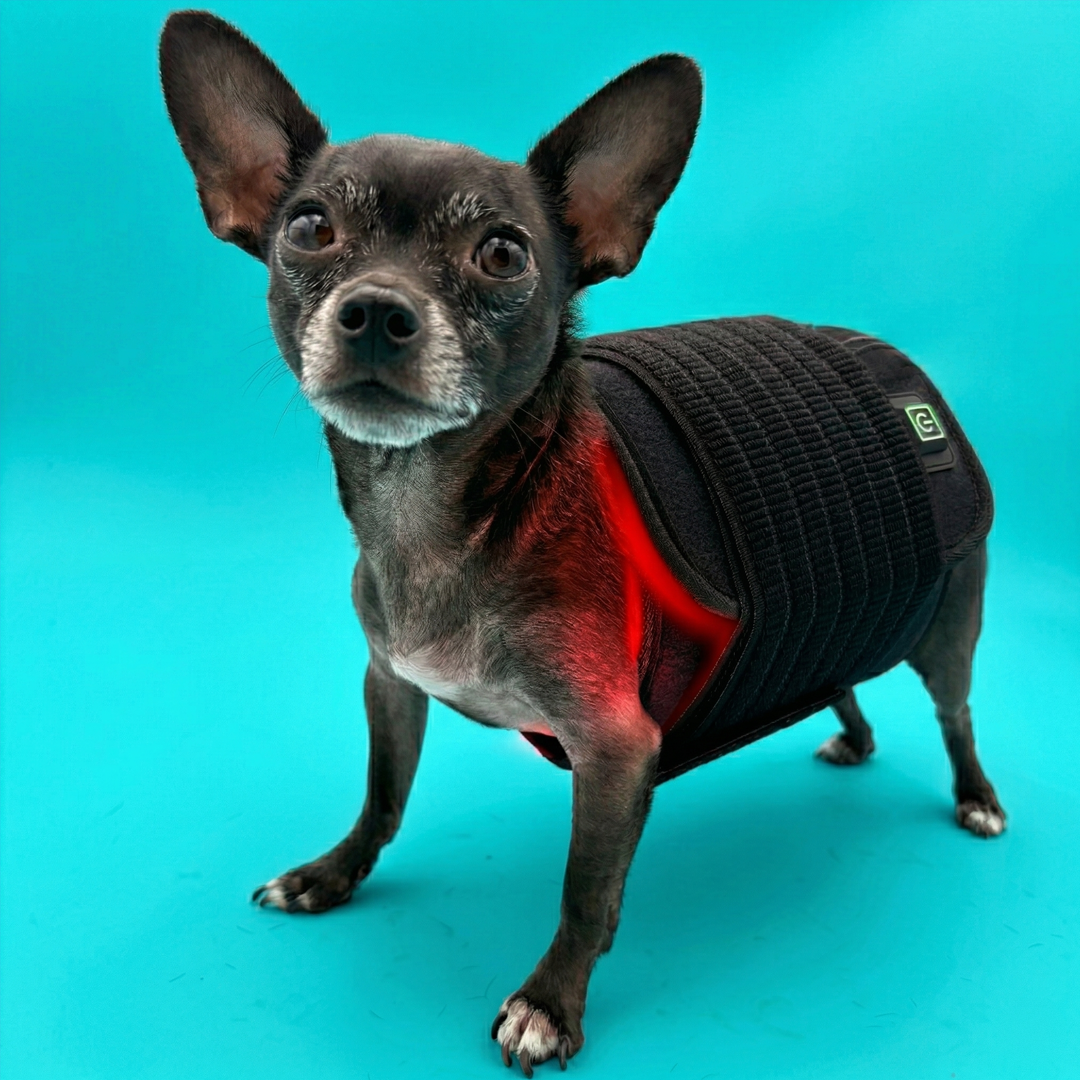
Does red light therapy actually work for dogs? An honest look at the evidence.
This page is for the dog owner who has read the wellness marketing copy and remained skeptical. It cites the studies by year and journal so you can verify them. It ranks the evidence by quality. It states what the evidence does and does not prove. It does not try to sell you on anything in the opening paragraphs.
Short Answer
Yes, for specific conditions, with moderate-to-strong peer-reviewed evidence. No, it is not a cure-all. The evidence is weaker for some claims that pet wellness marketing pages make.
20 min
Daily session
4 conditions
One mechanism
No metabolic load
Drug-free
DHospice-supported
IAAHPC recognized


EVIDENCE HIERARCHY
If you want the bottom line before reading further, here is what the evidence supports today.
Trust the upper tier most. Be more skeptical of claims in the lower tier.
The bottom line, ranked by strength of evidence
Strong evidence
Trust this
Canine osteoarthritis
Post-surgical recovery
Hip dysplasia
Wound healing
Weaker evidence
Be more skeptical
Cancer support claims
Cognitive support
Anxiety reduction
General "wellness"
Moderate evidence
Reasonably supported
IVDD (disc disease)
Pododermatitis
Cruciate post-op recovery
Soft tissue injuries
The mechanism, photobiomodulation of mitochondria, is well-established at the cellular level. The clinical translation to dogs has moderate-to-strong support for the conditions in the upper tier and continues to grow.

PEER-REVIEWED EVIDENCE
Peer-reviewed evidence: studies named by year and journal
2018 STUDYMost-cited evidence
Canine elbow osteoarthritis
Dogs with elbow osteoarthritis received red light therapy or sham treatment. After six weeks, the treatment group showed significant pain reduction and reduced reliance on pain medication. Researchers used accelerometers (objective activity measurement, not owner report) and recorded a marked rise in activity starting at week 2 with sustained improvement through week 6. This is the most cited study for canine arthritis.
Here are the most-cited peer-reviewed studies on red light therapy in dogs. Search by title or DOI to verify any of them.
2017 STUDYStrong evidence
Pre-operative bone surgery
Dogs undergoing bone surgery were divided into two groups. One received red light therapy before surgery, the other received placebo or sham. At eight weeks post-op, a higher percentage of dogs in the treatment group had healed. This addresses the surgical recovery use case.
PUBLISHED RESEARCHMultiple studies
Hip dysplasia and IVDD
Studies published in the Journal of Orthopaedic Surgery and Research and the Journal of the American Veterinary Medical Association have documented improvements in mobility and pain scores in dogs with hip dysplasia and intervertebral disc disease following photobiomodulation. Sample sizes vary. The clinical signal is consistent.
2016 STUDYModerate evidence
Canine pododermatitis
Dogs with pododermatitis (paw inflammation) received red light therapy. Improvement in lesion characteristics was documented. This addresses the wound healing and skin condition use case.
JOURNAL OF VETERINARY SCIENCE Replicated
Wound healing studies
A study published in the Journal of Veterinary Science documented faster wound healing in dogs treated with red light therapy compared to controls. This is one of the most replicated findings in the broader photobiomodulation literature, both in dogs and other species.
The pattern in the evidence: musculoskeletal applications (arthritis, hip dysplasia, post-surgery, IVDD) have the strongest support. Wound healing has consistent support. Skin conditions have moderate support. Quality of evidence varies by individual study. The cumulative pattern across studies is consistent enough to drive veterinary adoption.
For broader application context across all canine conditions, see our Red Light Therapy for Dogs hub.


VETERINARIAN ADOPTION
Veterinarian adoption as evidence of clinical confidence
A separate signal worth weighing alongside peer-reviewed studies: how many practicing veterinarians have decided to use this in their clinics.
43% of US veterinarians use red light therapy on canine arthritis patients
The International Association of Animal Hospice and Palliative Care has identified it as a promising non-pharmaceutical pain management option for senior dogs. Major veterinary journals including the Journal of the American Veterinary Medical Association have published multiple papers on its clinical use.
Veterinarians are not naive consumers. 43 percent adoption for a non-trivial billable in-clinic procedure means a lot of clinicians have observed it work in their own patients, often enough to justify investing in equipment and protocols. That is a meaningful clinical signal alongside the peer-reviewed literature.
The honest caveat: adoption is not the same as proof. Practitioners can be wrong, and reimbursement structure can drive adoption independently of evidence. Weight this signal alongside the peer-reviewed studies above, not in place of them.

HONEST LIMITS
What the evidence does NOT prove
Several limits of the evidence are worth knowing. If your dog has a serious medical condition, red light therapy belongs alongside veterinary care, not in place of it.
Sample sizes are modest
The canine clinical literature is smaller than the human and rodent literature. Many of the most-cited studies have modest sample sizes (10 to 40 dogs). The cumulative pattern is consistent, but individual studies should not be over-weighted.
It is not a cure
The evidence does not prove that red light therapy is a cure for any condition. It does not reverse advanced osteoarthritis or rebuild lost cartilage. It does not eliminate the need for pain medication in severe cases. It is not a substitute for surgery in cruciate ruptures, severe IVDD, or other structural conditions.
Wellness claims overreach
The evidence is weaker for conditions sometimes claimed by wellness marketing copy: cognitive support in older dogs, cancer support, anxiety reduction, and general wellness. There is some emerging research, but the strength of evidence is meaningfully lower than the musculoskeletal applications.
The honest framing: red light therapy reduces inflammation and pain, accelerates tissue repair, and supports cellular function. These are meaningful effects, but they are not cures. Where the evidence is robust (canine osteoarthritis, post-surgical recovery, hip dysplasia, wound healing), trust it more. Where the evidence is weaker, be more skeptical of claims.

ANECDOTES & REVIEWS
Evidence Ranked by Strength
Online reviews and anecdotes for pet red light therapy products skew positive. Survivor bias and placebo-by-proxy are both real. Survivor bias: people whose dogs improved are more likely to leave reviews than those whose dogs didn't. Placebo-by-proxy: the owner's expectation can change how they interpret subtle behavior.
User reviews are useful for product build quality and customer service signals. They are weak evidence for clinical effect.
How to think about anecdotes and online reviews
Weight the evidence accordingly. If you want clinical effect evidence, look at the peer-reviewed studies above and the veterinarian adoption rate first. Manufacturer data second. User reviews last.

Why the evidence makes biological sense: the mechanism
MECHANISM
What happens at the cellular level
Red and near-infrared light photons are absorbed by cytochrome c oxidase, an enzyme in the mitochondria that helps produce ATP, the energy molecule every cell uses for repair and function. The interaction stimulates ATP production, modulates inflammatory cytokines, and triggers nitric oxide release (which improves local blood flow). These effects are not species-specific. Mammalian cells respond similarly across species.
WALT (World Association of Laser Therapy) has established veterinary photobiomodulation protocols that veterinary clinicians follow when prescribing the therapy. This is the closest thing to a clinical standard the field has.
Photobiomodulation works at the cellular level. The mechanism is well-supported in cell biology research independent of any clinical claim.
Why this matters for the clinical question
The clinical question is whether this cellular-level effect translates to measurable patient outcomes. For canine osteoarthritis, post-surgical recovery, hip dysplasia, and wound healing, the answer based on peer-reviewed evidence is yes. For more speculative claims (cognition, cancer, general wellness), the answer is less clear and warrants more skepticism

DEVICE EVALUATION
If after reading this you decide red light therapy is worth trying for your dog, here is how to evaluate a device. For dogs with diagnosed arthritis specifically, the dog arthritis protocol covers placement, timing, and tracking detail beyond the device evaluation here.
If you decide to try it: what to look for
Wavelengths specified
660nm and 850nm are the standard therapeutic pair. Any device that doesn't publish its wavelengths should be skipped. Many cheap pet "red light" products use the wrong wavelengths or don't specify.
FDA registration, CE marking, RoHS compliance
Not a guarantee of efficacy, but a baseline manufacturing safety standard. Devices without these basics should be skipped.
Return policy
Most quality manufacturers offer 30 to 90 day returns. If the dog doesn't tolerate the device or the protocol doesn't show improvement after 4 to 6 weeks, you can send it back.
Irradiance specified
Irradiance is the energy density at the surface, measured in milliwatts per square centimeter. Higher numbers mean shorter sessions for the same dose. Look for at least 100 mW/cm². Devices that don't publish irradiance are usually low.
Built-in timer
Twenty minutes is the standard daily session. Auto-shutoff prevents over-exposure and makes the routine sustainable.
Photosensitivity awareness
Skip if your dog has a photosensitivity disorder, is on a photosensitive medication, or has active malignancy without veterinary supervision. Confirm with your vet.
Photosensitivity awareness
Skip if your dog has a photosensitivity disorder, is on a photosensitive medication, or has active malignancy without veterinary supervision. Confirm with your vet.
FREQUENTLY ASKED QUESTIONS
5 questions skeptical readers ask most
-
Several of the cited studies used objective measurement: accelerometers in the 2018 study, histological measurement in wound healing studies, radiographic measurement in hip studies. These aren't owner-reported subjective measures. They're physical measurements of activity, healing, and tissue. Placebo-by-proxy can affect owner reporting. It cannot affect accelerometer-measured activity.
-
FDA registration covers manufacturing safety standards, not clinical efficacy approval. There is no FDA "approval" for red light therapy as a treatment for any specific condition in dogs. The therapy is a medical device class with safety oversight, used as an adjunct to veterinary care.
-
43 percent of US veterinarians do use it for canine arthritis. Adoption has grown steadily over the past decade. The remaining 57 percent reflect: clinics that haven't invested in equipment, traditional pharmacology-first practice patterns, and clinicians who haven't kept up with the photobiomodulation literature. Adoption continues to rise.
-
Most have appropriate controls (sham/placebo groups, objective measurement). Sample sizes tend to be modest (10 to 40 dogs per study). Some are run at single institutions rather than multi-center. The cumulative pattern across studies is consistent enough to drive veterinary adoption, but individual studies should not be over-weighted in either direction.
-
Some dogs do not respond, or respond minimally. The studies show population-level improvements, not individual guarantees. If 4 to 6 weeks of consistent daily use produces no measurable change in your specific dog, the therapy isn't working for them. Return the device and try a different approach.


If after reading this you decide red light therapy is worth trying.
The Red Light Pet Mat from Red Light Wellness meets the device criteria above. It uses 660nm and 850nm wavelengths, delivers 140 mW/cm² irradiance, includes a 20-minute timer with auto-shutoff, carries FDA registration, CE marking, and RoHS compliance, and costs $137. There are other devices that meet these criteria. The Red Light Pet Mat is the one Red Light Wellness designed and stands behind. Set a 4 to 6 week trial. Use it daily. Track specific behaviors. If yours doesn't improve, return the device.
This article is for educational purposes and does not replace professional veterinary advice. If your pet has a diagnosed condition or is on medication, consult your veterinarian before adding red light therapy to their care routine.