

Practice type · Fitness & recovery
Red Light Therapy for Fitness Centers & Gyms
A gym competes on what members feel they get for their dues. Red Light Wellness® builds commercial red light therapy beds, Class II medical devices registered with the FDA, that turn a spare square of floor into a premium recovery amenity, an add-on members pay extra for, and a reason to choose your club over the budget box down the road.
American-made. Continuously engineered.
Build
Commercial-grade
Made in
FDA-registered facility
Wavelengths
Red: 625–670 nm
Near-Infrared: 830–910 nm
Session
10–15 min
Why gyms add it
A recovery amenity that sells memberships and keeps them.
Equipment is easy to copy and price is a race to the bottom. Recovery is where a serious club builds a moat. Commercial red light therapy earns a place on your floor for three reasons that feed each other.
A premium amenity that differentiates
A budget gym competes on ten-dollar dues and a wall of treadmills. It cannot answer a whole-body photobiomodulation (PBM) bed. A commercial red light therapy bed reads as the kind of feature that anchors a tour, justifies a higher membership price, and gives prospects a concrete reason to pick your club, not the cheapest one.
An upsell that lifts retention
Members who use recovery services cancel less. Fold red light into a premium tier or sell it as an unlimited recovery add-on and you create a standing reason to come back two or three times a week, plus an easy upgrade your front desk can offer on every join. That is recurring revenue and retention from the same station.
It completes a recovery zone
Fitness centers are building recovery zones alongside the weight floor, sauna, cold plunge, compression, stretch. Red light is the natural anchor. Because a full session runs under fifteen minutes, the bed adds a station to that circuit without becoming a bottleneck at the six-o’clock rush.
Photobiomodulation supports recovery, circulation, and skin and tissue health. Individual results may vary. Not intended to diagnose, treat, or cure any disease. Consult a healthcare professional before use.
Which Miracle model fits
Match the Miracle series to your traffic.
Every bed in the Wellness Collection delivers the same red (625–670 nm) and near-infrared (830–910 nm) wavelengths across a full-body treatment. You choose the model by how busy your recovery zone runs and by the electrical service your building already has.
Most clubs start here
The Miracle 5040 & 6200
The 5040 (504 mW/cm²) and 6200 (600 mW/cm²) both run on a standard 30-amp circuit, the easiest way to add a single recovery station to a boutique studio or a growing gym.
High-performance
Big Miracle 7200
More output and throughput for multi-providers.
720 mW/cm² irradiance · 2,400 LEDs · 40 AMP
Doctor Pro Edition
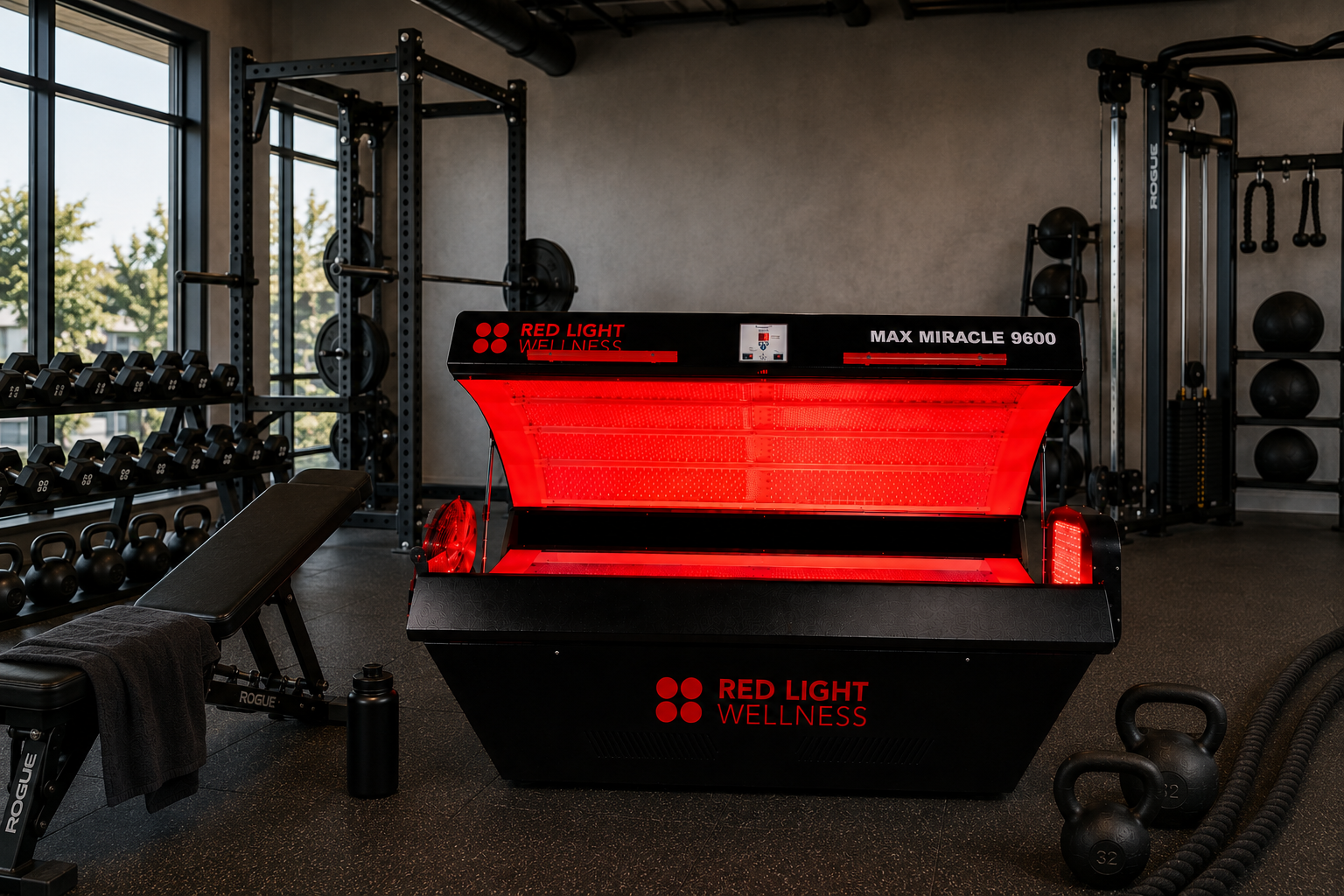
Max Miracle 9600
Higher output for a busy practice. Ask our sales team about available Doctor Pro options.
960 mW/cm² irradiance · 3,200 LEDs · 50 AMP
Room & throughput fit
One station, a real number of sessions.
A Miracle bed needs a private room of roughly 9′ × 8′ and a dedicated 220V circuit, 30 amps for the 5040 and 6200, more for the 7200 and 9600. Your full-body red light therapy bed should be positioned along the 9-foot wall. The elevated bench design makes entry and exit easy for members of every size and fitness level, which matters when the bed lives in a high-traffic recovery zone rather than a clinic.
Throughput is where the amenity earns its footprint. A full-body treatment runs 8–15 minutes. Add a couple of minutes to wipe down and reset between members and one bed realistically turns four to six sessions an hour. Across a full operating day that is a lot of member touchpoints from a single square of floor that used to hold a bench nobody used.
At a glance
What one bed asks for
~9’×8′
Private room footprint
4–6
Sessions per hour, one bed
220V
Dedicated circuit (30–50 AMP)
100k hr
Rated LED life
Photobiomodulation supports recovery, circulation, and skin and tissue health. Individual results may vary. Not intended to diagnose, treat, or cure any disease. Consult a healthcare professional before use.
ROI considerations
Where the revenue actually comes from.
For a gym, the strongest returns rarely come from one-off drop-ins. They come from attaching red light to the membership you already sell, so utilization stays high and the revenue is predictable month over month.
Add-on membership tiers
Add red light to a premium or “recovery” membership tier for a modest monthly bump over base dues, or sell an unlimited recovery add-on on top of any plan. An add-on tier turns the bed into recurring revenue instead of a schedule you refill daily. Our membership models guide lays out the tier structures that keep utilization steady.
Packages & day passes
Bundle red light into a recovery day pass or a personal-training package alongside cold plunge and compression, and it raises the value of the whole offer rather than competing with it. Members perceive more for their money and average revenue per member climbs.
Payback & financing
Model the numbers before you commit. Most clubs finance with a quick application and a soft credit check that won’t affect their score, then let add-on membership revenue cover the monthly payment. Run yours in the business ROI hub.
Revenue and payback vary by market, pricing, and utilization. Figures here are illustrative, not guarantees. Individual results may vary. Consult a healthcare professional before use.
Operational workflow
How a session runs on the floor.
Red light is one of the easiest amenities to staff, because the bed does the work and the process repeats cleanly. A typical member flow looks like this.
1 Book or walk in
Members book through your existing gym app or add a session at the front desk on their way past the recovery zone. First-timers get a short orientation and eye protection.
2 Session
The member settles onto the elevated bench for an 8–15 minute full-body treatment, usually right after a workout. Staff aren’t tied up, one attendant can keep several recovery stations moving.
3 Reset
Wipe-down surfaces make turnover fast for back-to-back gym traffic. The all-steel, powder-coated frame and field-replaceable LED modules are built for all-day duty.
4 Rebook or upgrade
Because results build with consistency, the natural close is the next session or a bump to the recovery tier, the moment retention gets reinforced.
Every bed ships turn-key: staff training, marketing materials, a vibration plate, and US-based support are included, so your team is confident selling and running sessions from day one. Backed by a 10-year frame warranty and a 2-year components warranty.
Fitness Center FAQ
Questions gym owners ask first.
-
Most clubs start with the Miracle 5040 or 6200 because both run on a standard 30-amp circuit and fit a single recovery-zone room. High-traffic or flagship locations move up to the Big Miracle 7200 or Max Miracle 9600 for shorter effective sessions and higher throughput at peak hours. The side-by-side comparison shows every spec.
-
Plan for a private room of roughly 9′ × 8′ and a dedicated 220V circuit, 30 amps for the 5040 and 6200, up to 50 amps for the 9600. Your red light therapy bed should be positioned along the 9-foot wall. See room requirements.
-
The strongest returns come from attaching it to membership. Add it to a premium recovery tier, sell it as an unlimited add-on, or bundle it into recovery day passes and personal-training packages. Our membership models guide and the ROI hub cover the structures and the payback math.
-
Every bed is a Class II medical device registered with the FDA, built in an FDA-registered facility in St. Louis, Missouri. When comparing manufacturers, ask each for their specific registration, precise regulatory language is one of the clearest ways to tell professional equipment from consumer imports.
-
Yes. Financing takes minutes to apply for and uses a soft credit inquiry that won’t affect your score, and every bed ships with training, marketing materials, and support. Request current pricing for a personalized quote.
Next steps
Bring whole-body red light to your gym.
Request current pricing or book a five-minute discovery call. We’ll help you pick the right Miracle model, plan the recovery-zone room, and map the payback against your membership tiers, no pressure, no obligation.