

To Pulse or Not to Pulse is the Question Photobiomodulation Administrators are Asking.
Pulsing is the intentional use of short bursts of light rather than a steady application of continuous light. It has become a trend for companies in the Photobiomodulation (PBM) market tout to differentiate themselves from one another. Since there is a lot of confusion about red light, near-infrared, far-infrared, and other therapeutic lights, as well as their beneficial wavelengths, it allows for a lot of companies to market and promote ‘new technology’ or ‘more beneficial’ features in their equipment that does not result in any real therapeutic benefit nor have scientific merit.
Does Pulsing Photobiomodulation Have Better Benefits?
The short answer is no. The LED pulsing frequency is measured in Hertz (Hz), which means cycles per second. If light pulses ten times per second, it would be measured as 10 Hz. Pulsing is typically administered in a 50:50 ratio, meaning that the pulses of light and intermittent pulses of “off-time” are equal in duration. Because the light is off as much as it is on, the intensity of pulsing light will only be half that of continuous light.
Though using the method of short pulsing light in infrared lasers is grounded in research (Hamblin used pulsed infrared lasers to slow down the heating of tissues to not result in the burning of tissue), in the case of red and infrared light/photobiomodulation therapies, it does not accomplish any added health benefits.
Ok, But What About the Combination of Other Light Therapies Like Blue Light?
Light therapy masks use the combination of blue and red light and have become popular and caught on as an overall skincare treatment. Yes, blue and red light does help the surface of the skin by tightening the skin, treating acne, reducing scarring, and other anti-aging functions. Full-body photobiomodulation is different because red and near-infrared wavelengths penetrate deeper into the body and stimulate cells and other molecular mechanisms, healing the musculoskeletal system rather than just the skin’s surface.
The Five Bioactive Lights in Humans
There are five types of bioactive light in humans – i.e., They affect the function of our cells.
Blue light—regulates the circadian rhythm in our brain, helping to regulate the different neurotransmitters and hormones.
UV light—allows us to synthesize Vitamin D.
Far-infrared—heats cells (this is part of the sun’s spectrum you feel as heat), stimulating cell and circulation change (used in infrared saunas)
Red light—acts on the mitochondria in our cells to stimulate increased cellular energy (ATP) production and other molecular mechanisms.
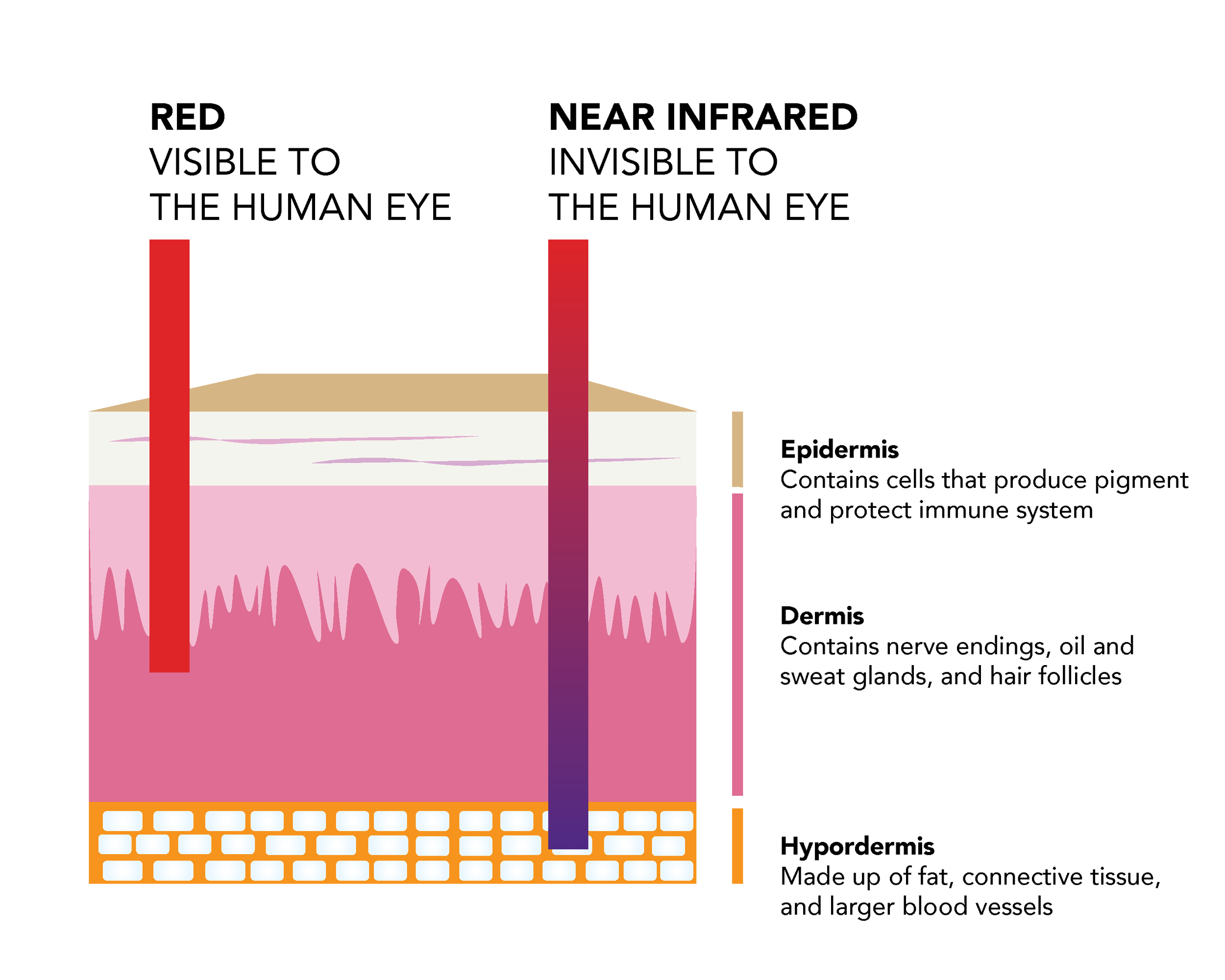
Near-infrared—acts similar to red light by stimulating the mitochondria but penetrates deeper into the musculoskeletal system, up to two inches.
Most other wavelengths cannot penetrate the body; red light and near-infrared light can. This penetration means we can use red light to literally power up – just as you would charge a battery.
Conclusion
There was a study conducted by Hamblin, the father of red light. In the study, he talked about using infrared lasers to slow down the heating of tissue so it would not burn the skin during treatment. Lasers are not what is used in this type of therapy anymore; instead, photobiomodulation therapy uses LEDs to deliver red and near-infrared treatments
The gold standard in LED photobiomodulation is continuous wavelengths of red and near-infrared. Particularly because the LEDs go through a range of wavelengths. I’ll explain in a future blog, so stay tuned!
Hamblin Laser Study https://www.ncbi.nlm.nih.gov/pmc/articles/PMC2933784/
The Red Light Wellness editorial team has forty years of expertise in light therapy and photobiomodulation (PBM) research. Red Light Wellness is an FDA Class II cleared medical device manufacturer based in St. Louis, Missouri. The company designs and produces commercial-grade red light therapy beds for chiropractors, medspas, physician clinics, and wellness practices across the United States. The editorial team combines engineering knowledge with clinical experience from working alongside these professionals daily. A multidisciplinary team develops this content. The team includes: · Biomedical engineers specializing in LED wavelength technology and therapeutic light delivery systems · Clinical advisors from our network of healthcare professionals who use Red Light Wellness equipment daily · Regulatory specialists who ensure all content aligns with FDA Class II cleared medical device standards · Wellness industry analysts tracking market trends Red Light Wellness operates from an FDA-listed facility in St. Louis, Missouri. The company designs and manufactures commercial-grade red light therapy beds used by healthcare professionals nationwide. Our clinical advisors are licensed healthcare practitioners who use our FDA Class II cleared medical devices in daily practice.