

Practice Type · Physician & Medical Clinics
Red Light Therapy for Physician Clinics
Red Light Wellness® builds commercial red light therapy beds that are Class II medical devices registered with the FDA. They provide physician practices with a patient-pay, non-pharmacological adjunct that fits into busy clinical workflows without adding staff or extending appointment times.
Family-owned. American-made. Continuously engineered.
Build
Commercial-grade
Made in
FDA-registered facility
Wavelengths
Red: 625–670 nm
Near-Infrared: 830–910 nm
Session
10–15 min
Why physician clinics add it
A patient-pay recovery and wellness service that fits inside a medical practice.
Primary care, integrative medicine, functional medicine, and concierge practices are under pressure to grow revenue that does not depend on insurance reimbursement. Whole-body photobiomodulation (PBM) is one of the clearest ways to do it: a self-directed wellness service patients pay for out of pocket, delivered on equipment your team already knows how to supervise.
An adjunct modality
Photobiomodulation is used in clinical settings as a non-pharmacological, non-invasive complement to conventional care, commonly positioned around recovery support, circulation, and general skin and tissue health, alongside a physician’s plan rather than in place of it.
Cash-pay economics
Sessions are offered as a wellness service patients purchase directly, typically single sessions, packages, or memberships. That keeps the offering outside the reimbursement cycle and predictable for your practice.
Low staff burden
A full-body treatment runs in under fifteen minutes and can be supervised by a trained medical assistant, so it rarely competes for physician or nurse-practitioner time.
Photobiomodulation supports recovery, circulation, and skin and tissue health. Individual results may vary. Not intended to diagnose, treat, or cure any disease. Consult a healthcare professional before use.
Which model fits
Matching a Miracle-series bed to a clinical floor.
Every bed in the Wellness Collection is a Class II medical device that pairs red light at 625–670 nm with near-infrared at 830–910 nm for a full-body treatment. Physician clinics usually choose by output and by the electrical service the room already has.
Entry professional
The Miracle 5040
The accessible way to launch a PBM service and test demand before scaling.
504 mW/cm² irradiance · 2,553 LEDs · 30 AMP
Higher volume
Big Miracle 7200
More output and throughput for multi-provider clinics running a full session book.
720 mW/cm² irradiance · 2,400 LEDs · 40 AMP
Doctor Pro Edition
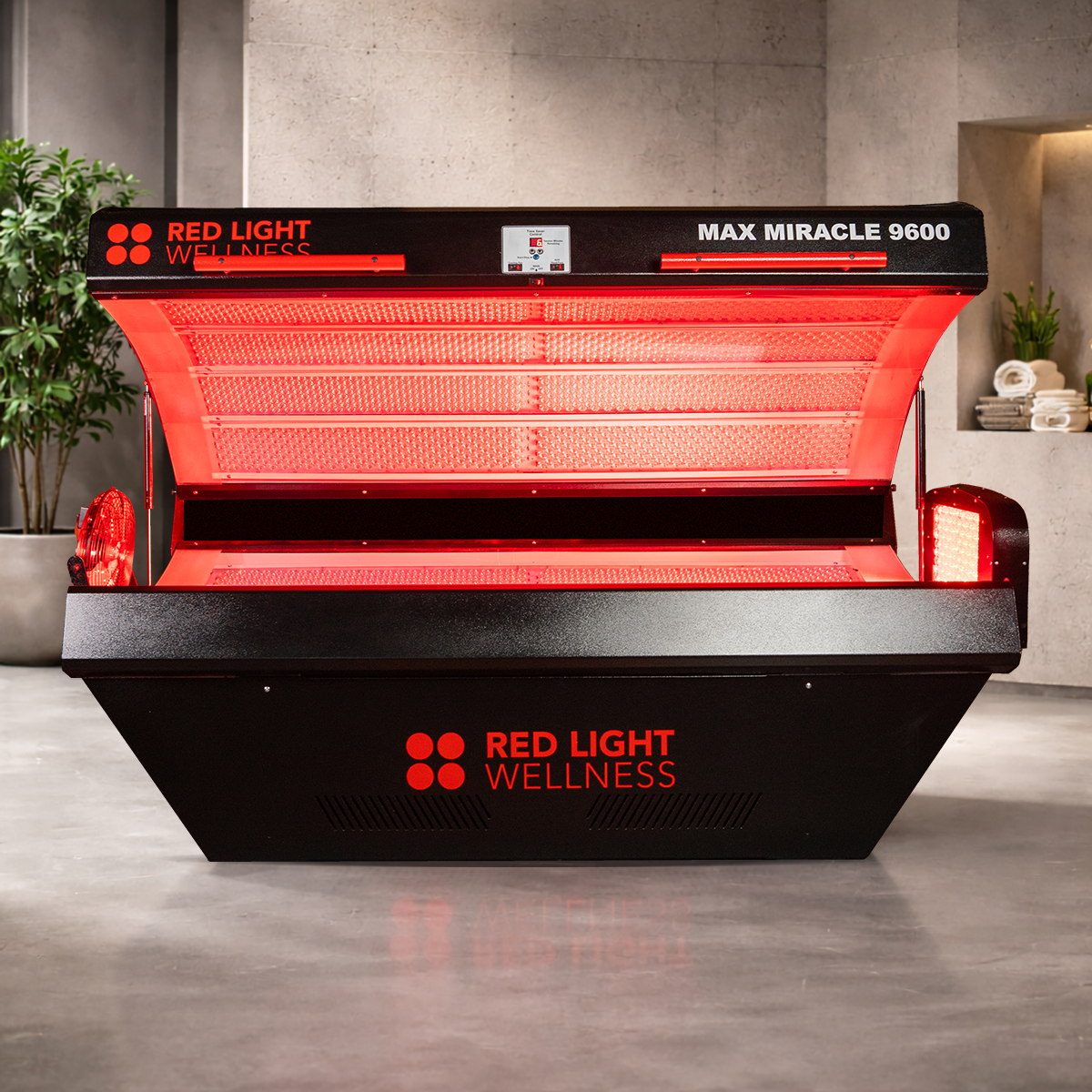
Max Miracle 9600
Higher output for a busy practice. Ask our sales team about available Doctor Pro options.
960 mW/cm² irradiance · 3,200 LEDs · 50 AMP
Room & throughput fit
Built for a real treatment room and a real schedule.
The Miracle 5040 and 6200 share a 93″ × 37.5″ × 51″ footprint, so they fit roughly an 9′ × 8′ room with clearance for entry, exit, and staff. Your red light bed must be positioned along the 9-foot wall. Both run on a dedicated 220V, 30-amp circuit; the Big Miracle 7200 steps up to 40 amps.
Throughput is where PBM earns its place in a clinic. Because output is high and even, a full-body treatment completes in eight to fifteen minutes. A single bed can turn several sessions per hour when the schedule is built around it, and the elevated bench design keeps entry and exit quick for patients of all sizes.
At a glance
Clinic-room essentials
~9′ × 8′ room for the 5040 or 6200
Dedicated 220V circuit, 30 amp (5040/6200) or 40 amp (7200)
Full-body session in 8–15 minutes
Supervisable by a trained medical assistant
All-steel frame, 100,000-hour rated LEDs, 10-year frame warranty
ROI considerations
How the numbers tend to work for a clinic.
Because sessions are patient-pay and short, a PBM service can contribute margin without pulling on insurance billing. The variables are straightforward: your per-session price, how many sessions you run per day, your operating days, and the modest operating cost of a low-draw device with long-life LEDs.
8–15 min
Session length driving daily capacity
Cash-pay
Single sessions, packages, or memberships
100k hr
Rated LED life keeps operating cost low
Payback depends on your pricing and utilization, not on a fixed equipment price, which is why we quote per configuration rather than publish a sticker. Most practices finance the bed with a quick application and a soft credit inquiry that does not affect their credit score, and the equipment may qualify for a Section 179 deduction. Model the math for your own clinic before you commit.
Revenue and payback figures are illustrative and depend on your pricing, utilization, and market.
Not financial or tax advice. Individual results may vary.
Clinical operational workflow
How a session runs inside a physician clinic.
1
Screen & consent
A provider or trained staff member reviews contraindications, sets expectations honestly, and documents informed consent for a wellness service that complements, never replaces, the patient’s medical care.
2
Position & protect
The patient uses the supplied eye protection and enters via the elevated bench. Staff set session time to your clinic’s protocol.
3
Treat & turn over
The full-body session runs in under fifteen minutes. Surfaces are wiped between patients, and the room resets quickly for the next appointment.
4
Record & rebook
Sessions are logged, and front-desk staff rebook against a package or membership to keep the bed utilized.
Every bed ships turn-key: staff training, marketing materials, a vibration plate, and US-based support, so the service is ready to run from day one. Because the Miracle series draws relatively little power and its LED modules are field-replaceable and rated for 100,000 hours, day-to-day upkeep stays minimal.
Individual results may vary. Not intended to diagnose, treat, or cure any disease. Consult a healthcare professional before use. Screening and consent protocols are set by your practice.
Physician clinic FAQ
Questions clinical buyers ask.
-
Every bed is a Class II medical device registered with the FDA produced in an FDA-registered facility. Registration reflects that the device and facility meet the FDA’s requirements for this class of professional therapeutic equipment. When you evaluate manufacturers, ask each for their specific FDA registration, precise regulatory language is one of the clearest ways to tell professional equipment from consumer imports.
-
We position whole-body photobiomodulation as a patient-pay wellness service rather than a reimbursed procedure, and we make no representation about coverage. Practices set their own pricing as single sessions, packages, or memberships. Confirm any billing or coding question with your own compliance and payer resources.
-
Keep the language evidence-honest. Photobiomodulation is generally described as supporting recovery, circulation, and skin and tissue health as an adjunct to medical care. It is not intended to diagnose, treat, or cure any disease, and it should never be presented as a substitute for a physician’s plan.
-
Most physician clinics start with the Miracle 6200 for its professional output on a standard 30-amp circuit, or the Miracle 5040 to launch a service on a smaller footprint. Higher-volume, multi-provider clinics often step up to the Big Miracle 7200. See the full side-by-side comparison.
-
The 5040 and 6200 fit roughly an 8′ × 8′ room and run on a dedicated 220V, 30-amp circuit; the 7200 needs 40 amps. We review your room and electrical service during planning so the bed is ready to run on delivery. See room requirements.
-
Pricing depends on configuration and current programs, so we send a personalized quote rather than publish a fixed price. Most practices finance with a quick application and a soft credit inquiry that won’t affect their score. Request current pricing.
Next steps for your clinic
Add a patient-pay PBM service the right way.
Request a personalized quote or book a five-minute discovery call. We’ll help you choose the model, plan the room, map the payback, and walk through financing, with no pressure and no obligation.